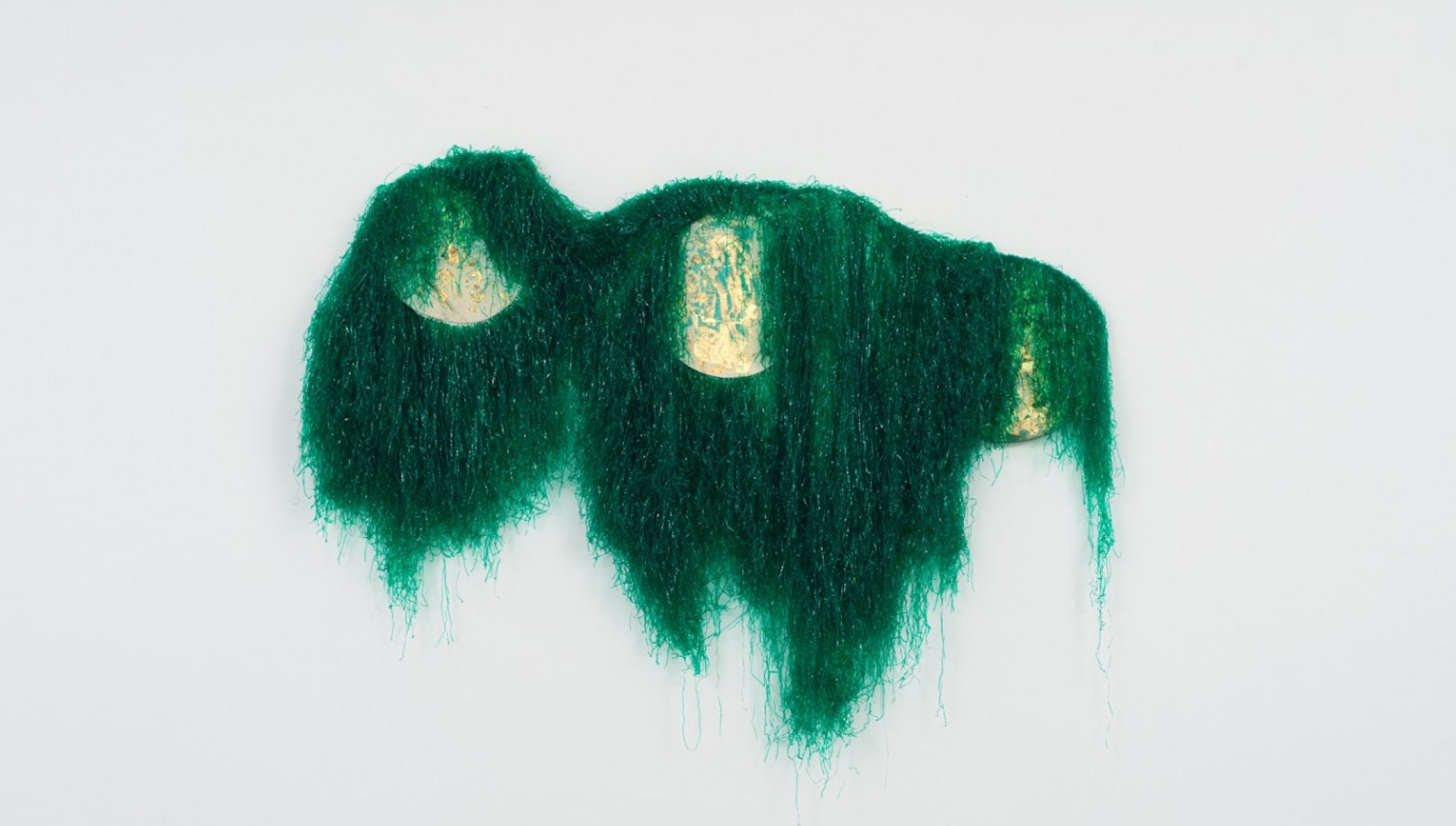
Serge Attukwei Clottey is famed for his use of cut up plastic jerrycans ironically known as Kufuor Gallons in his home country of Ghana after John Kufuor, the country President who oversaw the country during water shortages that plagued Ghana at the beginning of this century. Jerrycans initially used for cooking oil are repurposed to transport water in cities where access to running water has long been – and remains – an issue in the Greater Accra where as recently as 2011 it was estimated that only one-third of the population had access to piped water. As a child Clottey used to be sent to fetch water in jerrycans for the household.
Clottey’s practice is varied, encompassing sculpture, photography and video, performance, drawing and painting and his works frequently embodies a plurality of genres which defies easy categorization, a challenge that Clottey himself invites when he talks about “paint-less paintings” for his plastic tapestries. Pieces and patchworks of jerrycan HDPE will be used as elements of performance and installations before being literally and symbolically traded back to galleries and art collectors across the world.
In taking his art practice outside of the confines of exhibition spaces, Clottey follows the well-established precedents of land art and socially engaged art which both became prominent in the 1960s in reaction to modernism and as a critique first of the art establishment, and then as a broader institutional critique. In Clottey’s case, the aim of bringing art directly to people and symbolic places is integral, but not to escape, and rather stay at the place of his origins, which then becomes an integral part of his art.
Socially Engaged Practice
I make my work very accessible to the community, because I think the community is part of my process.
The attachment to the motherland is in the case of Clottey not just expressed by a return as is the case for many artists from African (and its diaspora), who give back to their birth or ancestral land after success abroad (Ablade Glover’s Glo Art gallery and the Artist Alliance in Accra, Toguo’s Bandjoun station, Mahama SCCA in Tamale, Kehinde Willey’s Black Rock in Dakar). Nor it is simply a desire not to move and anchor the practice in the homeland far from the ecosystem of the art world. Clottey’s art is about home — Adesa We: story telling home. At the same time the “home” is not very far removed from migration (also present in Toguo’s practice) which is symbolized in performances, the yellow brick road, and the trade of the jerrycans (first to Africa as oil container, and then back to rich countries as art).
Social practice is an integral part of Clottey’s art, which is steeped in the community of Labadi (‘La’) a neighborhood bordering the ocean in the capital city of Accra, where he lives and comes from. Clottey invites habitants from La to engage with his art, in and outside his studio, in the streets of the township, working with the community in the production of the art works.
Clottey works with GoLokal, a collective that has grown to about 100 people to produce performances and his artwork. Performances with GoLokal include: the Chale Wote festival since 2013; The Displaced, 2015; The Gods Must Be Crazy, 2015); My Mother’s Wardrobe, 2016; 360 La, 2018.
With GoLokal, Clottey addresses issues that are important to his Ga community history migration, the role of women, environmental pollution, access to water, and commercial exchange between the West and the South. These themes and the weaving of found materials into large tapestries owe of course to the discovery by El Anatsui in 1999 of the process. Clottey continues the discussion initiated by El Anatsui, but also expands it in several directions.
For instance, one cannot help but contrast Clottey’s studio with El Anatsui’s. Both practices are manual labor intensive. El Anatsui employs numerous assistants as Clottey does, but El Anatsui’s studio is calm and collected, a “sacred place” in the artist’s own words. Clottey’s studio on the other hand includes his home and extends to his neighborhood and its inhabitants who participate in boisterous performances. In the course of this socially engaged art practice, the material — carrying the “soul” of people who have been exposed to it, in the words of El Anatsui — of the jerrycans becomes then ubiquitous and activated through a varied array of artistic expressions. Beyond esthetic considerations of how the material is used in the artworks themselves, through careful and minute manufacturing as in the art of El Anatsui or instead almost ‘as is’ as in the works of Mahama, this singular plurality defines the art of Clottey.
Land Art
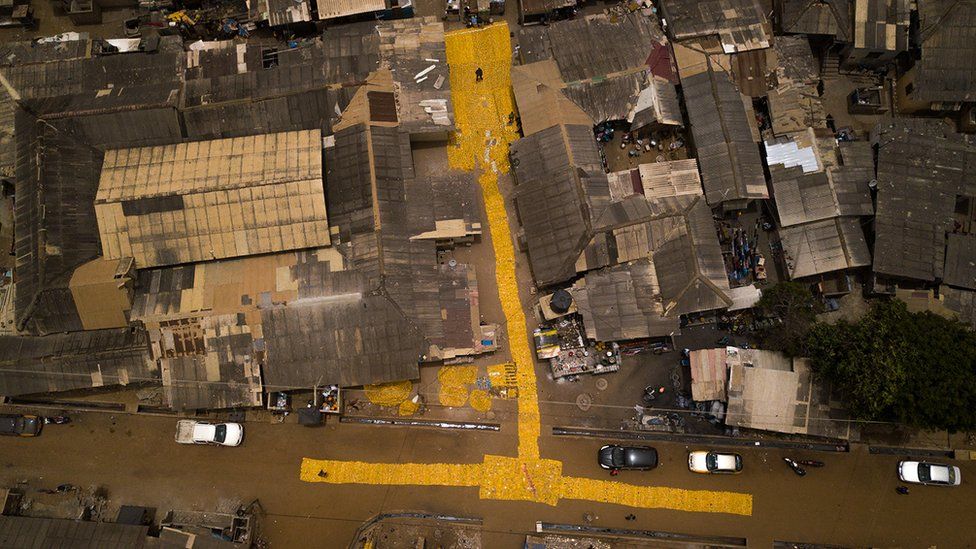
The site-specificity of Clottey’s practice has naturally extended to what is one of the most striking land art works in recent years in Africa. The Yellow Brick Road is a recurring street installation that covers the area around Clottey’s studio (made for the 360 La open exhibition (2018). Once again, Clottey convincingly expands the scope of his artistic expression. This work is notable for many reasons, including starting from the fact that land art remains underdeveloped in Africa, apart from South Africa and Strijdom van der Merwe who through his practice and Site_Specific an international land art event in South Africa. There are probably good economic reasons why land art is still rare in Africa, being a form of art that is ‘impossible’ to sell, and relies on strong art ecosystems, being dependent on patronage and requiring upfront investments.
In this relative void, Accra has recently been the site of a new land art expression in Africa with both Clottey and Ibrahim Mahama engaging in a direct dialogue with the city. Mahama was the first to gain prominence, receiving acclaim for representing Ghana at the 58th Venice Biennale in 2015, which under the curation of Nana Oforiatta Ayim and alongside fellow artists El Anatsui, John Akomfrah, Selasi Awusi Sosu, Lynette Adom-Boakye, Felicia Abban and David Adjaye (the pavilion’s architect) put Ghana on the art map. Mahama’s Occupation Series initiated first in Kumasi in 2012 cover buildings with quilts made of jute sacks that used to transport cocoa and coal. The discarded jute sacks, metonyms of absent bodies become to represent the manual labor “of many” behind the industries that used them and through his covering of public spaces by the jute sacks quilts (the Mallam Ata Charcoal Market in 2012, the KNUST Museum in 2013, the Adum-Kejetia Railway Footbridge Project in Kumasi, and the Civil Aviation building in Accra in 2014, the Malam Dodoo National Theatre, 2016, and the KNUST university Great Hall in 2018), Mahama symbolically reclaims them on behalf of the people.
Like Mahama, and recently El Anatsui (in the exhibition Triumphant Scale at Haus der Kunst), Clottey uses his material tapestries to cover buildings and outside spaces. This works invites also comparisons with the oeuvre of Christo and Jeanne Claude and its monumental use of fabric around buildings and natural landmarks. Undoubtedly the memorability of their work as well as the demonstration of the possible must have been an inspiration. However, as Mahama himself asserts the analogy as being lazy in the same way we shall say shallow critique tags Attukwei Clottey as an imitator of El Anatsui. The material in Christo and Jeanne Claude bears more the function of an instrument, in how it achieves a practical and aesthetic purpose in the intervention, which does not carry the meaning that the material used by El Anatsui, Mahama and Clottey does. The material used in the art of Christo and Jeanne Claude should not be reduced to simple aesthetics and functionality: their career was after all framed by the 1962 Berlin Wall project and the 2018 Mastaba which both used oil barrels as their constitutive elements. Nevertheless, it is true that there is a substantial symbolic and qualitative difference with the materials used by El Anatsui, Mahama and Clottey. Interestingly, the metonymic quality of the Kufuor gallons used by Clottey are not without reminding that of the oil barrels of Christo and Jeanne Claude.
Where Clottey is quite fundamentally different is in his direct relation with the community (something touched upon in the work of Mahama, especially his first instance of occupation in the market of coal merchants) and the social engagement of his art. Another characteristic of Clottey’s intervention is the landmark does not precede the intervention, but rather is created by the intervention itself. Indeed, unlike the works of Mahama he does not aim for a highly recognizable or symbolic landmark: his neighborhood in La is on the contrary unremarkable, rather undistinguishable from other parts of La and Accra: a lower middle-class Africa neighborhood among many.
In that sense, the yellow brick road could be compared with works like JR’s Women are Heroes in Kibera (2009) in Nairobi, and Vik Muniz’ Waste Land (2011) in Rio de Janeiro, which attracted the world’s gaze to places too easily ignored, although the comparison with both projects feels slightly uneasy given the vastly different motivations at play (and the intervention of artists who don’t belong to the place). But there is indeed a motivation in Clotteys’ yellow brick road to bring the attention to his immediate neighborhood and the challenges faced by its residents. Here the claim is not a symbolic occupation as in Mahama’s work, but a more direct claim for the affirmation of La resident’s property rights, with the yellow brick road as the property land marker.
This brings us to a second characteristic of Clottey’s project which its approach that is based on an informal economy where Kufuor gallons are purchased from and cut up by informal labor (remunerated by the artist) and the installation itself probably done without the need for any bureaucratic permitting and authorization (save from neighbors and family). Even more so, the project itself calls out bureaucracy for its inefficiency given the lack of enforcement of property rights.
This text appeared in Africanah.org