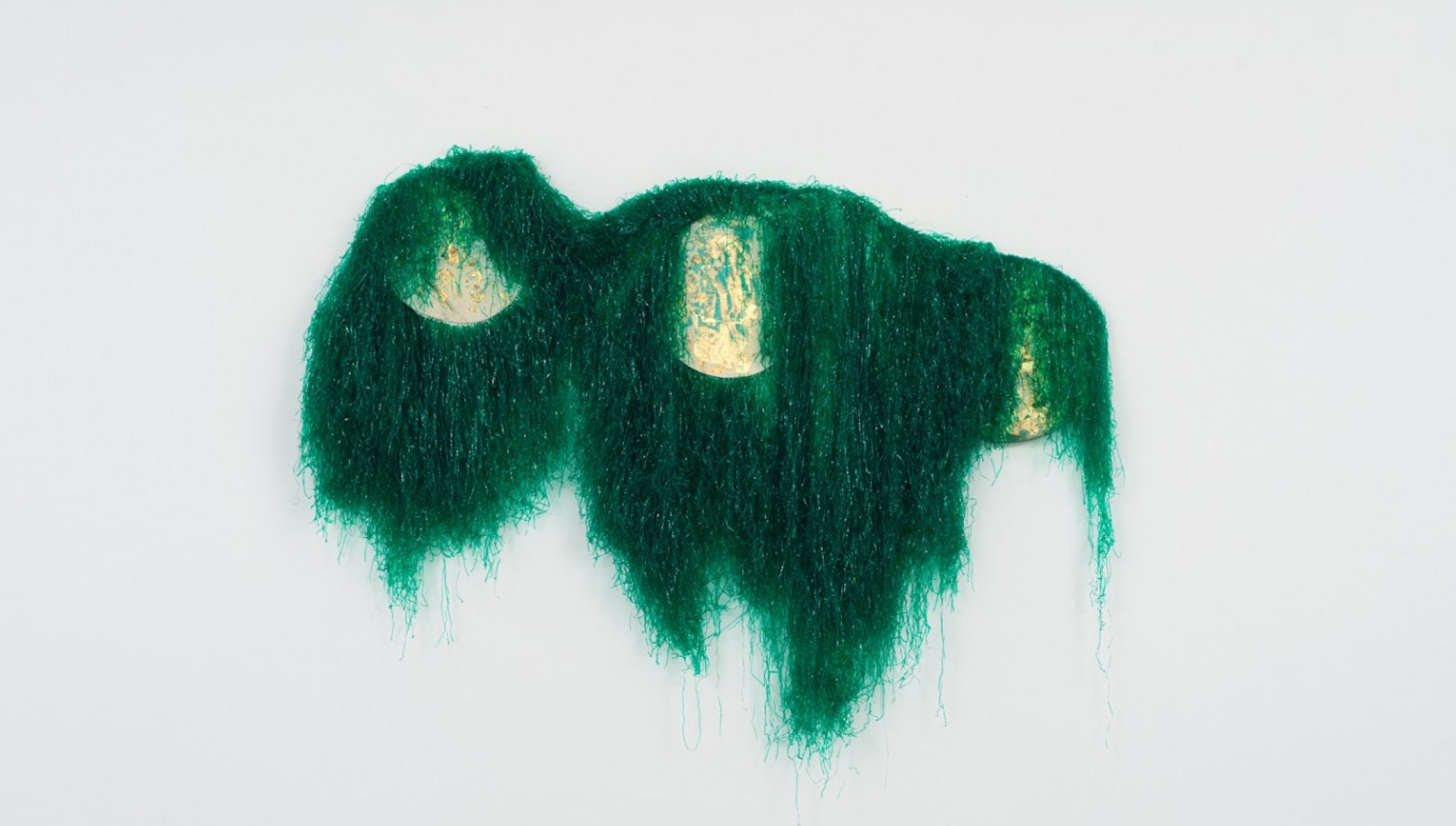
Seeking Histories and Futures in Soil

Starting in the mid-20th century, humans began to move around more soil than the natural forces of erosion and volcanic activity taken together — we became geological agents, as environmental historian John McNeill has written in Something New Under the Sun (2000). Land art took off at around the same time, with artists like Michael Heizer, Robert Smithson, and Walter De Maria changing the contours of remote places. Decades later we are contending with the consequences of our past actions as earth movers with limited understanding of soils and their histories. But as historian Gabrielle Hecht has argued, saying that “we” are terraforming agents responsible for erosion or ecosystem collapse obscures extractive histories and their unequal distribution among communities. Today’s artists often refrain from imprinting their vision upon the land, instead bringing the soil into the gallery as an archive of nature-human interactions: a cultural record of dispossession and abject ecologies, but also of resilience.

The land artists of the previous century also brought soil into the gallery on occasion — in the case of Walter De Maria’s 1977 “New York Earth Room,” recently reopened, no less than 250 cubic yards of earth weighing 280,000 pounds. But whereas the provenance of the soil was not important to De Maria, it is key to many of the artists working today. Kiyan Williams uses soil collected from sites of the African Diaspora: slave castles and sugar plantations in the Caribbean and the American South. Williams’s “Meditation on the Making of America” (2019), currently on view at the Hirshhorn Museum in Washington, DC, is made of earth collected around the home of the artist’s great-great-grandmother in St. Croix, as well as a nearby plantation, where she was an enslaved laborer. The soil is a migrant and the substructure of the nation, intermingled with the lives and remains of the people who have toiled to build it.

Many 20th-century land artists eschewed the gallery to create monumental works in faraway locations that were hard to access. Their remote geographies challenged both the institutional and physical confinement of the museum and the art market’s capacity to render their work “collectible.” One striking departure were Robert Smithson’s Nonsites, bins containing rocks and other elements from specific locations in New Jersey that were displayed in the gallery along with maps and photos of the original site. Smithson’s Nonsites bridged outside space and the gallery through ideas of deep time and geological process rather than human histories. Today’s artists are continuing to reshape the relationship between the gallery’s exterior and interior while rethinking the visitor’s access and, even, participation in their earth works. Kapwani Kiwanga dug up the material for her “Positive-Negative (Morphology)” (2018) installation right outside the Musée d’art de Joliette, in Quebec, where it was displayed.

Kapwani Kiwanga, Positive-Negative (Morphology), 2018, written protocol, soil dug out from museum’s land and placed in the museum’s exhibition space, 30 × 50 × 460 cm. Photo Romain Guilbault. Courtesy the artist. © 2023 Artists Rights Society (ARS), New York / ADAGP, Paris​.
Kapwani Kiwanga, “Positive-Negative (Morphology)” (2018), written protocol, soil dug out from museum’s land and placed in the museum’s exhibition space (© 2023 Artists Rights Society (ARS), New York / ADAGP, Paris; photo by Romain Guilbault, courtesy the artist​)

The museum is located on Nitaskinan territory, homeland of the Atikamekw First Nation, who are still negotiating their land claim with the governments of Quebec and Canada. Kiwanga removed soil in front of the museum and placed it in the gallery to highlight the colonial legacies that still shape relationships to the land. Unlike Claes Oldenburg, who dug a hole in Central Park behind the Metropolitan Museum of Art with the help of two grave diggers and then refilled it on the same day to create “Placid Civic Monument” (1967), the soil from Kiwanga’s excavation was “cooked” to eliminate any living organisms and then brought inside. Viewers were nudged out of their placidity by receiving a bucket and a protocol for returning the dirt to its source. Yet the sterilized soil behaves differently once re-embedded in its original location. The artist’s intervention has thus left a scar-like trace on the institutional grounds.

The current prominence of soil was evident in the recent Venice Biennale. In Delcy Morelos’s “Earthly Paradise” (2022), dark and moist soil rose above the ground to surround the viewer. Inspired by Andean and Amazonian cosmologies, the grave-like experience was imbued with the pervasive, intoxicating smell of earth mixed with cassava, cacao, cinnamon, and clove. These are plants that have traveled around the globe, bringing in their wake human migrations and transforming ecosystems; they are also reminders of soil’s capacity to absorb the dead to nourish the living.

Ιn Precious Okoyomon’s “To See the Earth Before the End of the World” (2022), soil in the gallery that supported an ecosystem of kudzu, sugarcane, and swallowtail butterflies was punctuated by sculptures composed of brown wool and blood. The installation restored the ghostly presence of toiling bodies of the past in a landscape of abundance that celebrated the resilience of nonhuman nature.

Today’s artists are rethinking the role of humans as geological agents transforming biota and landscapes. Their works are a reminder that soil is a finite and precious bridge between the animate and inanimate worlds, the foundry of life. In contrast to the monumentality of iconic land art works, these artists often engage in performative and ephemeral practices that invite the audience to participate in gestures of reparation and witnessing. They resist the idea of a dead earth-as-resource, choosing instead to reanimate the soil with past histories and future imaginaries.

Delcy Morelos, “Earthly Paradise” (2022), at the 59th International Art Exhibition—La Biennale di Venezia, The Milk of Dreams, 2022 (photo Yota Batsaki/Hyperallergic)
Installation view of Precious Okoyomon, “To See the Earth Before the End of the World” (2022) at the 59th International Art Exhibition—La Biennale di Venezia, The Milk of Dreams, 2022 (photo by Clelia Cadamuro, courtesy the artist)
Kapwani Kiwanga, “Positive-Negative (Morphology)” (2018), written protocol, soil dug out from museum’s land and placed in the museum’s exhibition space (© 2023 Artists Rights Society (ARS), New York / ADAGP, Paris; photo by Romain Guilbault, courtesy the artist​)

This essay appeared in Hyperallergic in May 2023

The plant-human hybrid is the cyborg of our moment

Artist Hugh Hayden’s work “Nude” (2021), featured in his solo exhibition “Boogey Men” at ICA Miami earlier this year, is the cyborg of our moment. The philosopher Donna Haraway proposed the cyborg in the 1980s as an answer to the capitalist, technocratic, and patriarchal subjugation of nature. If the solution to what Haraway described in her 1985 essay “A Cyborg Manifesto” as the “border war” between nature and culture born out of “the traditions of ‘Western’ science and politics” could then be imagined as a fusion of organism and machine, today it is urgently conceived as a plant-human. If technology seemed the greatest threat and promise four decades ago, the environmental crisis is center stage now.

Plants are invading the space of humans in art while human activity is invading every corner of nature

“Nude” is a headless skeletal figure made of bald cypress, sitting in a resigned or meditative posture with branches sprouting down its spine and along its limbs. Both personal and global in its fusion of wood with bone, the work taps into the artist’s family tree and that deep environmental current in contemporary art that wrestles with our forgotten embeddedness in the natural world. Plants are invading the space of humans in art while human activity is invading every corner of nature, threatening two-fifths of the world’s plants with extinction, even as we depend on their photosynthetic alchemy for the planetary life systems that sustain us.

Hayden’s plant-human is memorable but not solitary, rubbing shoulders with those of artists such as Barthélémy Toguo, Wangechi Mutu, and Firelei Báez. It is no accident that plant-human hybrids sprout in the work of artists from Africa and the African Diaspora, especially. Theirs are the global communities where the subjugation of plants in the plantation system accompanied the suffering of humans. If in Ovid’s Metamorphosis Daphne is transformed into a plant to avoid Apollo’s sexual violence, today’s plant-humans commemorate the kidnapping and brutality inflicted on millions of people and the human and environmental harm that resulted.

Cameroon, home to Barthélémy Toguo, was important to the Atlantic slave trade. In the 19th century the country was colonized by the Germans, and later the British and French, who profited from locally grown cacao, rubber, palm oil, and bananas. Toguo’s painting “Homo Planta I” (2018) translates the continent’s histories of forced labor into an agonizing posture punctuated by nails. Yet sap from the trees also flows through the body in a transferal of energy, linking the figure’s pathos to the ongoing threat to Cameroon’s rainforest. Moving between Paris, France and Bandjoun, Cameroon, in 2009 Toguo opened Bandjoun Station, an artist colony and coffee plantation. The home-grown coffee is sold in packets wrapped in the artist’s lithographs, highlighting the value of Africa’s natural resources. “We consider that it is not up to the West to fix the prices of our raw materials,” Toguo wrote in a 2018 exhibition catalogue.

Objectifying nature

Indigenous societies have practiced respectful reciprocity with their non-human kin for millennia. But in the modern period, Western states developed and exported techniques for objectifying nature, the better to subject her to extractive purposes. Modern systems of classification parsed out of the natural world into specimens that were removed from their ecological and cultural contexts, rendered interchangeable and thus amenable to scaled-up exploitation. Linnaean taxonomy, the binomial system of naming species introduced by 18-century Swedish botanist Carl Linnaeus and first applied to plants, exemplified the classifying urge that later underpinned ideologies of race and inequality. Societies viewed as “backward” or “inferior” were judged in need of improvement by Western colonizers.

The organizing impulse of taxonomy in the service of exploitative hierarchies is dismantled in works like Firelei Báez’s “Ciguapa Habilis (after Carl Linnaeus)” (2009). The Ciguapa, a creature of Dominican folklore, is a wild woman with beautiful hair, dangerously alluring but hard to track due to her backward-facing feet. She has been associated with Indigenous Taino culture but probably originates later, in the island’s Afro-Latin identities, oral traditions, and national mythmaking. Báez’ Ciguapa subverts racist and misogynist ideologies of passive femininity institutionalized under the Trujillo regime: her luxuriant hair is both plant thicket and serpentine braid and one of her hairy limbs ends in a fleshy heel. She defies categorization within nature or culture, showing kinship with the creatures of Wangechi Mutu.

The Kenyan artist’s collages, such as “Madam Repeateat” (2010), articulate hybridity through mixed assemblages harvested from fashion, travel, and pornographic magazines. Mutu’s collage practice captures the layered, fragmented histories of displacement and the complex, composite subjectivities they engender while interrogating racialized and sexist projections onto the Black female body. Her sculpture calls forth multispecies beings that seem eerily at home in our damaged world. Unlike the mythological Daphne fleeing sexual violence, Mutu’s “Tree Woman” (2016) confidently stands her ground.

By contrast, Hayden’s “Nude” lacks markers of race or gender. But in the ICA exhibition, it was exhibited near a hooded police car, while an earlier title for the sculpture used in the exhibition, “Roots,” recalls Alex Haley’s culture-shaping and controversial novel and the eponymous TV series from the 1970s. The family tree of Haley’s novel had its roots in the 18th-century slave trade in the Gambia and traced the horrors of the North American plantations. Hayden’s work ties these genealogies of human and ecological harm to today’s environmental crisis.

Unlike the exuberant, monstrous vitality of the other works mentioned here, Hayden’s hybrid is imbued with death, a sculpted emptiness. The relationship between human and plant is full of tension. Are the branches parasitic? Did they grow posthumously, or are they integral to a strange organism that can only be inferred from its remains? The haunting effect is reinforced by the monumental scale: The sculpture both commands and creates space, an environment for the viewer to circle around and peer through. The mood is elegiac, hinting at a past loss, or future extinction — of the human, at least. Whether the bare branches might sprout again, in a way no human skeleton can, is an open question.

This essay appeared in Hyperallergic in May 2022.