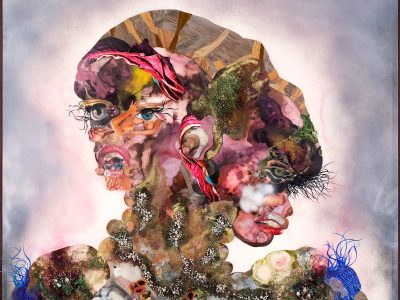
Artists Find Energy Justice in Grassroots Acts

In the 1970s, the humanist geographer Yi Fu Tuan speculated that “in some ideal future, our loyalty will be given only to the home region of intimate memories and, at the other end of the scale, to the whole earth.” Half a century later, Energies at the Swiss Institute adopts Tuan’s dual vision while dispelling any notion of an ideal attained. Instead, the show’s hyperlocal roots and global reach offer a trenchant critique of the power relations that inhere in the act of generating energy. The spark is a story of grassroots activism set in the 1970s East Village.

From the ravaged cityscape of the 1973 oil crisis sprang the first sweat equity co-op at 519 E 11th Street. On the roof, residents installed a two-kilowatt wind turbine paired with solar panels that supplied the community with electricity as it experienced frequent outages. Energies includes archival documents and works by Becky Howland and Gordon Matta-Clark, who were involved in local regeneration projects in the 1970s: Howland’s sculpture “Oil Tankers on Fire” (1983/1996/2024) and Matta-Clark’s Energy Trees (1972–73) drawing series. It also brings a contemporary lens to questions of energy justice through a sharply curated artist cohort.

Installation view of Energies at the Swiss Institute, New York. Left: Liu Chuang, “Untitled (The Festival)” (2011), single-channel video (color, sound), 5:14 min.; right: Saba Khan, “Indus Water Machine (number 3)” (2020), console, headphones, fixed LCD TV, plastic hook, USB, MP3 player, glass cube with lid, and LED strip light (image courtesy the Swiss Institute)

The show radiates into the neighborhood with a nearby mural by Otobong Nkanga (whose current monumental installation at MoMA is a must-visit) and a recreation of Matta-Clark’s rosebush enclosure at St. Mark’s Church. Inside the Swiss Institute, its three floors are replete with works that collectively attain planetary scope through quirky means: Vibeke Mascini’s installation powered by cocaine confiscated in the port of Rotterdam; Saba Khan’s retro-futuristic sculpture referencing World Bank-funded hydropower projects on the Indus River; Joar Nango’s structure made of wood, reindeer sinew, and the aforementioned halibut stomachs, used in Sámi architecture for their transparent and insulating properties; and Cannupa Hanska Luger’s mirror shields devised for water protectors of the Standing Rock Reservation.

The artworks are modest in size yet ambitious in concept, begging the question: How impactful are cerebral, historically informed interventions, in a perilous time for environmental safeguards? The exhibition’s origin story suggests an answer — the residents who erected the wind turbine were sued by the near-monopolistic Con Edison company for forcing it to buy back their surplus energy. With the unlikely support of a former Attorney General, William Ramsey Clark, they prevailed, opening a path for decentralized power production in the United States and, like the show that they inspired, planting hope in the rippling wake of small local acts.

This review appeared in Hyperallergic on December 19, 2024.

Penny Siopis’s “Poetics of Vulnerability”

Penny Siopis, the South African artist of Greek descent, should be a household name in contemporary art. Through a major retrospective that spans five decades of painting, video, sculpture, and installation, the National Museum of Contemporary Art in Athens (EMST) makes exactly that proposition. For Dear Life, curated by Katerina Gregos, is Siopis’s first such show in Europe. Works of breathtaking breadth and depth explore violence, memory, and what the artist has called “the poetics of vulnerability” in media ranging from oil paint and glue to ephemera and found film, spanning the intimate to the monumental.

True to its ambition, the retrospective includes work from each of Siopis’s major series, demonstrating the artist’s risk-taking and ever-evolving process. Formally disparate works are tied together by sensory and conceptual threads — with an emphasis on materiality and the interweaving of personal and public histories — that make her entire oeuvre far more than the sum of its parts.

Installation view of Penny Siopis: For Dear Life at the National Museum of Contemporary Art, Athens. Pictured: Cake series (1982) (photo Paris Tavitian)

Siopis first garnered attention for her Cake paintings (1980–84), rooted in her early experiences in the family bakery in Vryburg. These feed on cakes as symbols of celebration and commemoration, but also on their ephemerality: elaborate confections are destined to grow stale or be devoured, suggesting the intimate horror of aging and decay. Everywhere in her work, private and public histories are entangled. Growing up in the 1950s and ’60s, Siopis has described the bakery as a charmed space interrupted by the reality of apartheid. In the catalog Penny Siopis: Time and Again she recalls the day when one of the Black workers arrived at the family’s doorstep bleeding from an act of racial violence as “a traumatic moment in a kind of idyll.”

Very different in style are the History paintings (1985–95), whose baroque excess draws on European traditions of allegory. History painting, long considered the most elevated genre of classical European art, was originally unavailable to women, who were steered instead toward still life and domestic themes. “Melancholia” (1986) offers an ironic take on this legacy of exclusion by pairing classical sculpture with food and flowers: an orgy of consumption that doubles as a critique of Western ideological and extractive sprawl. Another important work, for its provocative medium and theme in 1980s apartheid South Africa, is “Patience on a Monument: ‘A History Painting’” (1988). Siopis combines a collage of racist images from school textbooks with a thick impasto, conveying in both form and matter the banal dissemination of colonial ideology as a catastrophe of meaning, edging out truth by filling the mental and pictorial horizon to the brim. A Black Patience figure seated at the center recalls cultural critic Walter Benjamin’s reading of Paul Klee’s “Angelus Novus“: the angel of history whose face is turned toward the past experienced as an ever-mounting pile of ruins. She is quietly peeling a lemon. This generative intermingling of mundane and rarefied references is a signature of Siopis’s style and key to its layered signification.

So is innovation born of Siopis’s idiosyncratic collecting, shown in her video works (1994–2021). The artist spliced together home movies found in flea markets with her mother’s family footage and added soundtrack and captions. “My Lovely Day” (1997) draws on her grandmother’s exilic stories of the Greek-Turkish population exchange and Siopis’s own diasporic identity to draw parallels between Greek and South African political violence and trauma.

The halting, ghostly assemblages bear witness to larger narratives, from the unlikely assassination of the architect of apartheid, H.F. Verwoerd, by the Greek Mozambican migrant Demetrios Tsafendas in “Obscure White Messenger” (2010) to the quiet epidemic of domestic violence running alongside COVID in “Shadow Shame Again” (2021). Historical narrative is stitched together from the contingent, flawed visual archives of strangers and embroidered with the pathos of transience and loss.

The same aesthetic of the assemblage assumes a radically different form in Siopis’s installations, Charmed Lives (1998–99) and Will (1997–ongoing). In these still-growing, ever-morphing accretions of personal, found, and gifted objects — some of which are destined to be dispersed among the artist’s friends upon her death — human itineraries are charted through the social lives of things.

Penny Siopis, “Charmed Lives” (1998–99), three panels, ∼78 3/4 x 59 x 20 inches (200 x 150 x 50 cm); Collection of the artist (photo Paris Tavitian)

Siopis’s practice draws on many theoretical currents: feminism, anthropology, psychoanalysis, late 20th-century French philosophy. But concept is not allowed to dominate matter or empty it of its tactile, sensuous appeal and, often, horror. Her thick application of paint takes on the texture of food or skin in the Cake series; her melding of figure and ground unsettles the division between abstraction and figuration in the more recent Pinky Pinky series (2002–4). Pinky Pinky is an urban legend in South Africa that speaks to the uncanny cultural and sexual tangle of female adolescence: a half-human, half-animal creature that prowls on prepubescent girls in restrooms. Here, the artist plays with the limits of form at its most visceral, “dragging it to the verge of formlessness,” as she notes. Color and texture that trouble the boundary between skin and flesh, bodies both intact and flayed, or distilled into a single anatomical part with its appendages of teeth or nails, Pinky Pinky embodies materiality outstripping language to convey an unspeakable or nameless dread.

Few artists have such power to make us aware of our dual modes of cognition, cerebral and visceral. Few artists compel the visitor to alternate between the states of perpetrator and sufferer, viewer and viewed, intimacy and exposure.

The exhibition is the flagship event of a year-long cycle, centered on female-identified artists, titled What If Women Ruled the World? A possible answer might be that cultural amnesia about past violence and its ongoing legacies is harder to maintain in the presence of Siopis’s haunting entanglement of the body in history.

This review appeared in Hyperallergic in November 2024.

Georges Adéagbo Channels a Humanized Abraham Lincoln

Create to Free Yourselves—Abraham Lincoln and the History of Freeing Slaves in America, which opened on November 18 at the Smithsonian Museum of African Art, is the culmination of more than two decades of artist Georges Adéagbo’s fascination with the United States president. The exhibition, curated by Karen Milbourne, reinvents at scale an installation by Adéagbo that was shown at Lincoln’s Cottage in DC early in 2023. Its inception goes back decades, to Adéagbo’s original vision for an installation on the steps of the Lincoln Memorial. Its current incarnation was informed by a 2021 fellowship that enabled the artist, born in 1942 in Cotonou, Benin, to research Lincoln and channel the collection of memorabilia — including letters, artifacts, and clothes — located in the Smithsonian Museum of American History into his art.

The exhibition’s location on the National Mall matches the confidence of Adéagbo’s vision of Lincoln. Yet visitors may be surprised and challenged at first by the show’s eclectic materiality. Adéagbo is the artist in the archive, but also acts as collector, explorer, and curator. In his characteristic style, the installation brings together everyday or discarded objects, often sourced from local flea markets, alongside African sculptures and painted tableaux commissioned from artisans in Benin, as well as second-hand books, photographs, vinyl, and even a lost toy recovered from the park that surrounds the museum. The effect is humanizing and lyrical, yet highly conceptual. It brings high and popular culture, global networks and local belonging, the foreign and the familiar, into poetic proximity.

Most unsettling and poignant is the artist’s communion with Lincoln, across time and within this contained universe of associations. Central to one of the radiating assemblages, which resemble shrines, is an equestrian statue of Lincoln in a top hat, carved in Benin and facing an African sculpture. The objects’ encounter is suffused with the loneliness and pathos of Lincoln’s unfinished life’s work: Adéagbo was inspired by Lincoln’s daily commute from the Soldiers’ Home to the White House in the summer. The itinerant motif subtly recalls the global circulations, often forced and violent, that enslaved millions of people and brought artifacts into Western collections. The artist teases out the exploitative and exhibitionist currents in aesthetic traditions and museum display practices, yet his world-making reclaims the emancipatory values of creative expression, movement, and cross-cultural exchange.

Perhaps most astounding is the way an installation composed of seemingly modest elements conveys the role of Lincoln as a figure of not only American but global significance. It is no accident that Adéagbo has, all along, imagined his intervention as located at the center of the US capital, in the heart of the national narrative. Several years in the making, the exhibition has uncanny timeliness. Adéagbo’s cosmopolitan gaze exposes the parochialism of racist rhetoric, the shamefulness of narrow national interest, the fallacy of ignoring the interconnectedness of past and present, here and elsewhere. And he reclaims the violence of forced and cruel journeys, sublimating them into a sense of freedom and even exuberance: creating to free yourself.

This review appeared in Hyperallergic in March 2024.

Seeking Histories and Futures in Soil

Starting in the mid-20th century, humans began to move around more soil than the natural forces of erosion and volcanic activity taken together — we became geological agents, as environmental historian John McNeill has written in Something New Under the Sun (2000). Land art took off at around the same time, with artists like Michael Heizer, Robert Smithson, and Walter De Maria changing the contours of remote places. Decades later we are contending with the consequences of our past actions as earth movers with limited understanding of soils and their histories. But as historian Gabrielle Hecht has argued, saying that “we” are terraforming agents responsible for erosion or ecosystem collapse obscures extractive histories and their unequal distribution among communities. Today’s artists often refrain from imprinting their vision upon the land, instead bringing the soil into the gallery as an archive of nature-human interactions: a cultural record of dispossession and abject ecologies, but also of resilience.

The land artists of the previous century also brought soil into the gallery on occasion — in the case of Walter De Maria’s 1977 “New York Earth Room,” recently reopened, no less than 250 cubic yards of earth weighing 280,000 pounds. But whereas the provenance of the soil was not important to De Maria, it is key to many of the artists working today. Kiyan Williams uses soil collected from sites of the African Diaspora: slave castles and sugar plantations in the Caribbean and the American South. Williams’s “Meditation on the Making of America” (2019), currently on view at the Hirshhorn Museum in Washington, DC, is made of earth collected around the home of the artist’s great-great-grandmother in St. Croix, as well as a nearby plantation, where she was an enslaved laborer. The soil is a migrant and the substructure of the nation, intermingled with the lives and remains of the people who have toiled to build it.

Many 20th-century land artists eschewed the gallery to create monumental works in faraway locations that were hard to access. Their remote geographies challenged both the institutional and physical confinement of the museum and the art market’s capacity to render their work “collectible.” One striking departure were Robert Smithson’s Nonsites, bins containing rocks and other elements from specific locations in New Jersey that were displayed in the gallery along with maps and photos of the original site. Smithson’s Nonsites bridged outside space and the gallery through ideas of deep time and geological process rather than human histories. Today’s artists are continuing to reshape the relationship between the gallery’s exterior and interior while rethinking the visitor’s access and, even, participation in their earth works. Kapwani Kiwanga dug up the material for her “Positive-Negative (Morphology)” (2018) installation right outside the Musée d’art de Joliette, in Quebec, where it was displayed.

Kapwani Kiwanga, Positive-Negative (Morphology), 2018, written protocol, soil dug out from museum’s land and placed in the museum’s exhibition space, 30 × 50 × 460 cm. Photo Romain Guilbault. Courtesy the artist. © 2023 Artists Rights Society (ARS), New York / ADAGP, Paris​.
Kapwani Kiwanga, “Positive-Negative (Morphology)” (2018), written protocol, soil dug out from museum’s land and placed in the museum’s exhibition space (© 2023 Artists Rights Society (ARS), New York / ADAGP, Paris; photo by Romain Guilbault, courtesy the artist​)

The museum is located on Nitaskinan territory, homeland of the Atikamekw First Nation, who are still negotiating their land claim with the governments of Quebec and Canada. Kiwanga removed soil in front of the museum and placed it in the gallery to highlight the colonial legacies that still shape relationships to the land. Unlike Claes Oldenburg, who dug a hole in Central Park behind the Metropolitan Museum of Art with the help of two grave diggers and then refilled it on the same day to create “Placid Civic Monument” (1967), the soil from Kiwanga’s excavation was “cooked” to eliminate any living organisms and then brought inside. Viewers were nudged out of their placidity by receiving a bucket and a protocol for returning the dirt to its source. Yet the sterilized soil behaves differently once re-embedded in its original location. The artist’s intervention has thus left a scar-like trace on the institutional grounds.

The current prominence of soil was evident in the recent Venice Biennale. In Delcy Morelos’s “Earthly Paradise” (2022), dark and moist soil rose above the ground to surround the viewer. Inspired by Andean and Amazonian cosmologies, the grave-like experience was imbued with the pervasive, intoxicating smell of earth mixed with cassava, cacao, cinnamon, and clove. These are plants that have traveled around the globe, bringing in their wake human migrations and transforming ecosystems; they are also reminders of soil’s capacity to absorb the dead to nourish the living.

Ιn Precious Okoyomon’s “To See the Earth Before the End of the World” (2022), soil in the gallery that supported an ecosystem of kudzu, sugarcane, and swallowtail butterflies was punctuated by sculptures composed of brown wool and blood. The installation restored the ghostly presence of toiling bodies of the past in a landscape of abundance that celebrated the resilience of nonhuman nature.

Today’s artists are rethinking the role of humans as geological agents transforming biota and landscapes. Their works are a reminder that soil is a finite and precious bridge between the animate and inanimate worlds, the foundry of life. In contrast to the monumentality of iconic land art works, these artists often engage in performative and ephemeral practices that invite the audience to participate in gestures of reparation and witnessing. They resist the idea of a dead earth-as-resource, choosing instead to reanimate the soil with past histories and future imaginaries.

Delcy Morelos, “Earthly Paradise” (2022), at the 59th International Art Exhibition—La Biennale di Venezia, The Milk of Dreams, 2022 (photo Yota Batsaki/Hyperallergic)
Installation view of Precious Okoyomon, “To See the Earth Before the End of the World” (2022) at the 59th International Art Exhibition—La Biennale di Venezia, The Milk of Dreams, 2022 (photo by Clelia Cadamuro, courtesy the artist)
Kapwani Kiwanga, “Positive-Negative (Morphology)” (2018), written protocol, soil dug out from museum’s land and placed in the museum’s exhibition space (© 2023 Artists Rights Society (ARS), New York / ADAGP, Paris; photo by Romain Guilbault, courtesy the artist​)

This essay appeared in Hyperallergic in May 2023

The plant-human hybrid is the cyborg of our moment

Artist Hugh Hayden’s work “Nude” (2021), featured in his solo exhibition “Boogey Men” at ICA Miami earlier this year, is the cyborg of our moment. The philosopher Donna Haraway proposed the cyborg in the 1980s as an answer to the capitalist, technocratic, and patriarchal subjugation of nature. If the solution to what Haraway described in her 1985 essay “A Cyborg Manifesto” as the “border war” between nature and culture born out of “the traditions of ‘Western’ science and politics” could then be imagined as a fusion of organism and machine, today it is urgently conceived as a plant-human. If technology seemed the greatest threat and promise four decades ago, the environmental crisis is center stage now.

Plants are invading the space of humans in art while human activity is invading every corner of nature

“Nude” is a headless skeletal figure made of bald cypress, sitting in a resigned or meditative posture with branches sprouting down its spine and along its limbs. Both personal and global in its fusion of wood with bone, the work taps into the artist’s family tree and that deep environmental current in contemporary art that wrestles with our forgotten embeddedness in the natural world. Plants are invading the space of humans in art while human activity is invading every corner of nature, threatening two-fifths of the world’s plants with extinction, even as we depend on their photosynthetic alchemy for the planetary life systems that sustain us.

Hayden’s plant-human is memorable but not solitary, rubbing shoulders with those of artists such as Barthélémy Toguo, Wangechi Mutu, and Firelei Báez. It is no accident that plant-human hybrids sprout in the work of artists from Africa and the African Diaspora, especially. Theirs are the global communities where the subjugation of plants in the plantation system accompanied the suffering of humans. If in Ovid’s Metamorphosis Daphne is transformed into a plant to avoid Apollo’s sexual violence, today’s plant-humans commemorate the kidnapping and brutality inflicted on millions of people and the human and environmental harm that resulted.

Cameroon, home to Barthélémy Toguo, was important to the Atlantic slave trade. In the 19th century the country was colonized by the Germans, and later the British and French, who profited from locally grown cacao, rubber, palm oil, and bananas. Toguo’s painting “Homo Planta I” (2018) translates the continent’s histories of forced labor into an agonizing posture punctuated by nails. Yet sap from the trees also flows through the body in a transferal of energy, linking the figure’s pathos to the ongoing threat to Cameroon’s rainforest. Moving between Paris, France and Bandjoun, Cameroon, in 2009 Toguo opened Bandjoun Station, an artist colony and coffee plantation. The home-grown coffee is sold in packets wrapped in the artist’s lithographs, highlighting the value of Africa’s natural resources. “We consider that it is not up to the West to fix the prices of our raw materials,” Toguo wrote in a 2018 exhibition catalogue.

Objectifying nature

Indigenous societies have practiced respectful reciprocity with their non-human kin for millennia. But in the modern period, Western states developed and exported techniques for objectifying nature, the better to subject her to extractive purposes. Modern systems of classification parsed out of the natural world into specimens that were removed from their ecological and cultural contexts, rendered interchangeable and thus amenable to scaled-up exploitation. Linnaean taxonomy, the binomial system of naming species introduced by 18-century Swedish botanist Carl Linnaeus and first applied to plants, exemplified the classifying urge that later underpinned ideologies of race and inequality. Societies viewed as “backward” or “inferior” were judged in need of improvement by Western colonizers.

The organizing impulse of taxonomy in the service of exploitative hierarchies is dismantled in works like Firelei Báez’s “Ciguapa Habilis (after Carl Linnaeus)” (2009). The Ciguapa, a creature of Dominican folklore, is a wild woman with beautiful hair, dangerously alluring but hard to track due to her backward-facing feet. She has been associated with Indigenous Taino culture but probably originates later, in the island’s Afro-Latin identities, oral traditions, and national mythmaking. Báez’ Ciguapa subverts racist and misogynist ideologies of passive femininity institutionalized under the Trujillo regime: her luxuriant hair is both plant thicket and serpentine braid and one of her hairy limbs ends in a fleshy heel. She defies categorization within nature or culture, showing kinship with the creatures of Wangechi Mutu.

The Kenyan artist’s collages, such as “Madam Repeateat” (2010), articulate hybridity through mixed assemblages harvested from fashion, travel, and pornographic magazines. Mutu’s collage practice captures the layered, fragmented histories of displacement and the complex, composite subjectivities they engender while interrogating racialized and sexist projections onto the Black female body. Her sculpture calls forth multispecies beings that seem eerily at home in our damaged world. Unlike the mythological Daphne fleeing sexual violence, Mutu’s “Tree Woman” (2016) confidently stands her ground.

By contrast, Hayden’s “Nude” lacks markers of race or gender. But in the ICA exhibition, it was exhibited near a hooded police car, while an earlier title for the sculpture used in the exhibition, “Roots,” recalls Alex Haley’s culture-shaping and controversial novel and the eponymous TV series from the 1970s. The family tree of Haley’s novel had its roots in the 18th-century slave trade in the Gambia and traced the horrors of the North American plantations. Hayden’s work ties these genealogies of human and ecological harm to today’s environmental crisis.

Unlike the exuberant, monstrous vitality of the other works mentioned here, Hayden’s hybrid is imbued with death, a sculpted emptiness. The relationship between human and plant is full of tension. Are the branches parasitic? Did they grow posthumously, or are they integral to a strange organism that can only be inferred from its remains? The haunting effect is reinforced by the monumental scale: The sculpture both commands and creates space, an environment for the viewer to circle around and peer through. The mood is elegiac, hinting at a past loss, or future extinction — of the human, at least. Whether the bare branches might sprout again, in a way no human skeleton can, is an open question.

This essay appeared in Hyperallergic in May 2022.

Visions of Plants

Fipan Grass is the first exhibition outside Africa for Cameroonian artist Bienvenue Fotso (born 1989 in Bandjoun). Fotso is part of a new generation of painters from Cameroon, one of the countries at the forefront of the revolution in contemporary visual arts from the Continent, that claims globally famous artists like Barthélemy Toguo and Pascal Martine Tayou, as well as world-class curators such as Simon Njami, Koyo Kouoh, and Bonanventure Nkdikung. On view at African Arts Beats, in Washington, DC, the exhibition is named after a grass used in Cameroon to treat fevers, alluding to two key themes of Fotso’s practice: plants and healing.

Like several of her successful peers (Bernard Ajarb Ategwa, Jean-David Nkot, Boris Nzebo, and Marc Padeu), Fotso uses acrylic in clean and carefully composed graphic compositions of flat color surfaces in a distinct and memorable individual language. A key element of Fotso’s practice is her focus on plants. Her integration of natural motifs echoes Toguo’s, but with a different palette and formal identity that puts plants front and center. Her depiction of recognizable plants connects her to other African artists (Otobong Nkanga, Alida Rodriguez, or Kapwani Kiwanga) whose botanical investigations address history and community. They, in turn, reflect a broader botanical emergence in contemporary art, fueled by urgent environmental questions of biodiversity loss, deforestation, and climate change in the Anthropocene. (1)

Fotso1
Tsem (2021), courtesy of the artist and African Art Beats
The color palette of Fotso’s canvases surprises. In Tsem (butter fruit tree in Bamileke), Fotso eschews the trademark green and brown we associate with plants and proffers instead a cocktail of blues and purple. The fruit is full of tiny molecule-like bodies, evoking the seeds but also the fundamental chemical compounds that render plants uniquely valuable. Moving from landscape to plant portrait, Fuchsia, like Tsem, features Fotso’s trademark spiral and employs a palette of blues and light pinks against which the eponymous protagonist pops out. The confluence of plant and color is a subtle reminder of the aesthetic importance of plants, as a perennial subject in art history, as the source of dyes and motifs, and even as a lens of aesthetic experience (“periwinkle,” “rose,” and “indigo” are some of the innumerable color names that allude to plants). In Fwomajyé, cool colors dominate, enlivened by silver specks and the delicate suggestion of movement. Fotso’s gold and silver hues recall again the alchemy of plants that convert the energy of the sun into sustenance for almost every other living organism on earth.
Fotso2
Fwomajyé (2022), courtesy of the artist and African Art Beats

Historically, flower painting has been viewed as a minor genre, traditionally associated with women who were barred from more prestigious genres such as a history painting. (2) The work of artists such as Maria Sibylla Merian or Margaret Mee attest to the importance of many women botanical artists who were prized for both their aesthetic and scientific contributions, of course. And plants in Dutch Golden Age painting, for instance, were key conveyors of class, status, and spirituality. But the painting of flora has often been considered a genteel pastime, suitable for the accomplished amateur. During the period of European imperial expansion, innumerable encounters with local floras inspired scientific illustrators and botanists but also women who had followed their families to the colonies. The botanical portraits we find in the work of Fotso signal a starkly different historical moment, where plants occupy the center of critical inquiry, and where artists negotiate these global transfers and their human and environmental legacies.

Fotso’s work is at its strongest when it draws the viewer’s attention to the individuality of plants, as in plant portraits such as Taraxacum officinale (dandelion). Although plants are powerful carriers of cultural and historical meanings, their potency is attenuated when they are reduced to transparent symbolism or anthropomorphized to elicit the viewer’s emotional engagement. In King of Herbs the coexistence of the plant and built environment recalls what Donna Haraway has called “natureculture,” the inseparability of human and non-human in the Anthropocene. At this moment, when human activity is reaching every corner of the planet, it is impossible to conceive of nature as a separate, independent entity. This interpenetration of nature and culture is frequently conveyed in Fotso’s work by the intrusion of the built environment into the forest landscape.

Fotso3
King of Herbs (2022), courtesy of the artist and African Art Beats
Fotso is both deeply attuned to the human dependency on plants and concerned about the loss of biodiversity and indigenous knowledge in Cameroon. These concerns and insights come together in her frequent representations of medicinal plants, such as the dandelion of Taraxacum Officinale, the moringa tree of Never Die, and the mallow of Malva Neglecta. Fotso comes from a family of healers and is intimately familiar with traditional plant-based medicine. In her community, the male head of the clan is usually the holder of knowledge about medicinal plants. While growing up, she frequently accompanied her great uncle on forest expeditions to collect bark, leaves, and roots with healing properties. These are still of immediate relevance and utility to many communities: despite the rise in synthetic medicines, a large part of the world’s population, especially in the Global South, still depends on plant-derived medicines and traditional healing practices. But the forest that provides these useful medicines is threatened. Not only are the ecosystems that supply the plants increasingly endangered through environmental degradation, deforestation, and over-exploitation; but the traditional knowledge of the healing properties of plants, developed over millennia, is at risk of being lost, stored in the memories of elders and transmitted mostly by word of mouth. By making these plants the protagonists of her canvases, Fotso calls for the viewer’s attention, respect, and care.
Fotso4
Never Die (2021), courtesy of the artist and African Art Beats
Some of Fotso’s most alluring plant portraits are of weeds—plants usually perceived as unwanted interlopers or colonizers yet valued as food or medicine in her community. Fotso’s portraits elevate them and celebrate their value while questioning corrosive ideologies of purity. From there it is easy to draw a parallel with questions of migration. Many of the plants have often been deliberately transplanted from their native environment, and some escaped cultivation to exhibit invasive behavior in landscapes disturbed by humans. Reviled for being out of place, they show incredible tenacity and capacity for survival. Fotso’s Taraxacum Officinale takes the common dandelion and transforms it into a glowing presence, in the process establishing that there is no such thing as a common plant. The dandelion was brought into North America as a valued medicinal plant by European settlers. It became part of Native American pharmacopoeia and is also used for healing in the artist’s native Cameroon. Like many plants that become weeds in new environments, the dandelion thrives on disturbed sites—the result of human activity—and can grow in the narrowest cracks of paved ground. From that disrupted and denuded environment the dandelion rises up, no longer an anthropomorphic chimera but a vibrant plant portrait in the foreground, its distinctive flower glowing and its seed pod ready to disperse the next generation of plants.
Fotso5
Taraxacum Officinale (2020) courtesy of the artist and African Art Beats
Fotso’s plant portraits subtly drive home the often-overlooked fact that migrations have been happening two-ways for centuries. While it is common to think of plants imported from the colonies, plants have also gone the other way. Some of the staples of today’s Africa originate, for instance, in South America. Consider cassava, a poisonous plant made available for human consumption by the indigenous experimentation and knowledge of the peoples of South America before it traveled to Africa to become a food staple for millions of people. Another native of South America, the avocado tree, appears in Fotso’s Invasion (2020). Known to the West for its culinary uses, in Fotso’s painting the avocado is commemorated for its use by traditional healers in Cameroon who prize its anti-inflammatory and anti-fungal properties. The global movements of plants illuminate local reinvention and ingenuity.

1. Giovanni Aloi, Why look at plants? The botanical emergence in contemporary art. Brill Rodopi: 2019.
2. Yota Batsaki, “The Apocalyptic Herbarium,” Environmental Humanities, 13(2) (2021), 391–413.

This text appeared in Africanah.org

Sleeping pools

The rectangular shape of the bedframe doubles as the archetypal shape of the swimming pool, while the green glow of the LED lights suggests the lit, shimmery pool at night, a vision of luxury and indulgence. A quintessential marker of privilege found in the exclusive, white South African suburbs, the pool is often glimpsed behind high fences topped with broken glass and surrounded by manicured lawns that have inspired another of Gqunta’s work, Lawn (2016/7). The broken Coca Cola bottles of Lawn, used to protect properties from intruders, connote the reach of global capitalism as well as the makeshift petrol bombs used in protests in South Africa’s townships, at the other end of the social and racial divide.

Interrogating the legacies of apartheid

Lungiswa Gqunta  creates performance art, sculpture, and multisensory installations that interrogate the legacies of Apartheid and colonialism. Her practice often incorporates common and found objects — salvaged bed frames and discarded bottles — alongside more overt signifiers of violence and exclusion, such as barbed wire.

Gqunta’s  political sensibility infuses even the most mundane and domestic things with incendiary potential, as in the brushes equipped with matches instead of bristles shown in the 2018 exhibition Qwitha at WHATIFTHEWORLD gallery in Cape Town. The brushes appeared in the video Feet Under Fire, where the artist’s legs are shown walking in scrubbing brushes instead of shoes, and in a wall sculpture. Used to polish the stoep or entrance steps/porch of Cape houses, the matchstick brushes combine intimacy and insurrection, violence and domesticity .

Despite its seemingly serene name, Sleeping Pools, another work featured in Qwitha, partakes of the same incendiary spirit. The sculpture was made in an edition of 3, with two additional artist’s proofs, of which this work is one. Like Lawn, Sleeping Pool brings together in a tense and combustive relation the suburb and the township. Petrol makes a disquieting reappearance in Sleeping Pools as a substitute for water. Both works are precarious containers of an unsettling green that is soothing and toxic by turns. The play on pool/bed brings the tension home, at the heart of domesticity and of post Apartheid South African society. The title suggests a collective sleep, a surface oblivion of conflict lurking in the depths. Perhaps the incendiary smell of petrol will serve as a wakeup call:  “Our house, as in our whole country, is on fire, and who is gonna put it out? We have to collectively come together to put it out, as Black people. Not even just South Africans, but the entire continent.”

Smell

Smell is important to Gqunta’s social and political practice, nudging the viewer beyond the passive visual consumption of the work toward a full-body experience that is intellectual and emotional. Contemporary art often incorporates senses beyond vision, with the olfactory component in recent resurgence. Smell assails us, entering our body, conjuring up memories, inciting calm, or unease. It is a sense “mired in paradox,” seemingly immediate yet culturally inflected. The exhibition of Sleeping Pools in Qwitha posed a challenge to the visitors—the intrusive smell of petrol winnowing out those visitors who chose to remain in the presence of the work, despite being assailed by the strong fumes, from those who gravitated outside for socializing and a respite from the overpowering smell.

Having grown up in one of the largest townships of South Africa, the artist is preoccupied with accessibility and the freedom of movement. She is troubled by the fact that her work is shown in places where her community, her people, are not able to see or engage with it. Sleeping Pools calls on its viewers to stay with the experience of discomfort. Later, when they go home, they carry the smell of petrol on their clothes, a bit of the experience of the work follows them home.

Green is the new black

Thebe Phetogo’s haunting paintings stun the viewer with their vivid green. Not one of the soft greens found in nature but mineral, chemical pigments redolent of the color of absinth and cobalt bromide. A bright artificial green, a poisonous, magic substance. A green that suffuses the paintings, challenges the eye and is a door to the invisible, the unacknowledged.

Phetogo will have his first solo show in the United States with Van Ammon Co in Washington, DC, in November, his third solo in a little more than a year, following Ka Go Lowe at Guns and Rain in Johannesburg in March and Black Body Composites at Kó in Lagos in November 2020. The artist, born in 1993 in Serowe, Botswana and currently based in Cape Town, South Africa, engages with the complex and deep tradition of Black representation in both novel and provocative ways.

Representation

Phetogo invokes chroma keying, the visual-effects technique that employs a uniformly colored screen as background to a subject on camera, whereby allowing for a different background to be added in post-production. In theory, chroma keying can work with any background color, but green and blue are commonly used because they are most distinct from human skin tones. The green screen is preferred for live television, since people often opt for blue clothing, and it has therefore become the metonym for the technique.

Phetogo shares the green screen metaphor with another rising star, Sandra Mujinga, a Norwegian artist born in the Democratic Republic of Congo. Like Phetogo, Mujinga interrogates the fraught tradition of the representation of the black body and the invisibility of black skin. In Mujinga’s worlds, “Green is ultimately Black.” In an interview with the poet Olamiju Fajemisin, who remarked that “people describe black as an ‘absence’ of color, an ‘absence’ of light,” Mujinga interjected that “it’s the opposite.” Starting from the premise that black is the combination of all colors, the artist zeroed in on the duality that interests her and that also informs Phetogo’s practice: black is everything (all colors), but black is also emptiness depending on the (mis)perception of others. Or, in the words of the narrator of Ralph Ellison’s Invisible Man: “I am invisible, understand, simply because people refuse to see me.”

Tshetlha, with a bit of pomp, 2021 Courtesy Von Ammon Co and the artist 

The green screen is a perfect vehicle for this duality crucial to black representation since it can potentially represent everything, “all colors,” but is also empty, signifying absence. The fertile metaphor of the green screen explains how two artists working in distinctly different media —Phetogo’s paintings versus Mujinga’s sculpture, video, and installations—nevertheless converge on the use of green to interrogate the (in)visibility of the black body.

While the green screen is a key metaphor, Phetogo’s paintings also draw their power from the unsettling emotions bright green pigments can convey. Especially when associated with skin tone, green is a signal of illness of the mind or body, often linked to the absorption of noxious substances. From the Impressionists’ absinth drinkers to the Blaue Reiter and Die Brücke painters to Edvard Munch, green has been associated with a break from classical painting and exploration of the margins. The disturbance created by the bright green pigment continues to be critical and generative today, as in the work of Salman Toor, for whom green is “glamorous,” “poisonous,” “intoxicating,” and “nocturnal,” creating a third space that allows new subject positions and identities to emerge.

Beyond the green screen, Phetogo has also been inspired by the concept of “black body” in physics, where it refers to an ideal object that absorbs all the light that falls on it, thus becoming invisible to measuring instruments. However, physics’ black bodies are theoretical constructs, not a reality: the invisibility of any body in the universe comes down to a limitation of perception. Phetogo explores this blindness in the series of works he presented in Blackbody Composites.

Descent to Zone, 2020 Courtesy Guns and Rain and the artist

Rewriting the narrative of blackness as absence of light also connects Phetogo to an important tradition of Black representation and recalls Glenn Ligon’s account of his conception of Warm Broad Glow (2005), his first neon work. When visiting the workshop of a neighbor who was fabricating neon signs, Ligon asked whether it would be possible to produce neon letters in black. It wasn’t, he was told, because black is the absence of light. Ligon proceeded to come up with a process that enabled him to create black neon letters for his work.  In the words of the narrator of Ellison’s Invisible Man, explaining how he tapped a power line to light his underground living: “I’ve illuminated the blackness of my invisibility.”

Invisibility

Ellison’s novel has been a key literary point of reference for many artists, beginning with Gordon Parks’ photographs for Life magazine of Ellison himself, to Faith Ringgold, David Hammons, Kerry James Marshall, Glenn Ligon, Hank Willis Thomas, and Jeff Wall to name a few major figures. It is not surprising to see their fingerprints in Phetogo’s work alongside the strong overtones of Ellison’s novel.

blackbody as a Bodyprint (after David Hammons), 2020 Courtesy Guns and Rain and the artist

Phetogo references Marshall in one of the works for his MA thesis. Phetogo’s Portrait of a blackbody as his Material Self pays homage to Marshall’s A Portrait of the Artist as a Shadow of His Former Self. Marshall questioned the invisibility of black skin through his black-on-black technique, demonstrating that the richness of the palette of blacks allows him to paint with the same freedom as any other colors. Marshall himself was preceded knowingly or unknowingly by Faith Ringgold’s “Black Light Series” from 1967. Two portraits from Ringgold’s series in particular, Man and Woman, use the chromatic strategy of the black background from which the color of the skin and the face emerge through a call to attention and close looking. At the end of Invisible Man the narrator refuses to “strive toward colorlessness” and affirms that his “world has become one of infinite possibilities.” Phetogo’s answer to the black-on-black technique is to place the black body against the green screen: a negation of blackness as an absence of light, relocating it against the background of infinite possibility, and affirming painting “as a stand-in for history and the world at-large.”

Minstrelsy

The black body has endured not only violence and erasure, but also attempts at abasement through gross caricature, another aspect of Black representation that Phetogo explores with vigor. This thread, too, can be traced back to Ellison: “My eyes fell upon a pair of crudely carved and polished bones, ‘knocking bones’ used to accompany music at country dances, used in black face minstrels; the flat ribs of a cow, a steer or a sheep, flat bones that gave off a sound, when struck, like heavy castanets (had he been a minstrel?).”

Phetogo’s signature use of black shoe polish to paint his figures against the green screen, as well as the googly eyes and exaggerated white teeth of their disturbing smiles, signal another troubling tradition of black representation, blackface. A work like Portrait of a blackbody as his Material Self engages directly with blackface—yet disrupts its meaning given that the Motswana artist is interrogating the tradition from the space of the African continent. As Phetogo notes, minstrelsy as practiced in some countries in Africa did not carry a derogatory meaning. Black American minstrel artists came to Ghana and Nigeria in the 1920s, inspiring the Concert Parties form of theater.  The rich web of references in Phetogo’s paintings thus both place him in dialogue with the tradition of questioning and reinventing the canon of Black representation, while affirming the multiplicity of black artists’ geographical, cultural, and subject positions and confronting viewers with their racist prejudices and histories.

Roy, 2021 Courtesy Von Ammon Co and the artist

The green and the minstrel-like characters (bright green, googly eyes, carnivalesque attire) are strongly reminiscent of the paintings of James Ensor (The IntrigueThe Strange Masks). In the crowd of Ensor’s Christ Entry Into Brussels in 1889 one sees two characters in blackface in the background. There are also references to Congo masks in the painting. Ensor draws on the grotesque aspect of masks to offer a satire of social convention, also drawing from the traditions of carnival of the Low Countries, where blackface characters (Zwarte Piet) had been part of Saint Nicholas celebrations since the middle of the nineteenth century.

If the uncanny is a return of the repressed, then Phetogo invites us to refamiliarize ourselves with the tired and violent stereotypes of Black representation, as if to exorcize them. Engaging with the historical economies of racist imagery through citation and repetition, his art shows how “visual referents circulating in different geographic and exhibitionary context generate their own image worlds,” countering the commodification or invisibility of black bodies.

Phetogo plays with multiple registers that lend his works their strong evocative power. His richly layered practice invites inquiry and reflection, while his keen awareness of historical context opens up cultural and historiographical depths of meaning.

This text appeared in Africanah.org

Follow the yellow brick road

Yellow brick road

Serge Attukwei Clottey is famed for his use of cut up plastic jerrycans ironically known as Kufuor Gallons in his home country of Ghana after John Kufuor, the country President who oversaw the country during water shortages that plagued Ghana at the beginning of this century. Jerrycans initially used for cooking oil are repurposed to transport water in cities where access to running water has long been – and remains – an issue in the Greater Accra where as recently as 2011 it was estimated that only one-third of the population had access to piped water. As a child Clottey used to be sent to fetch water in jerrycans for the household.

Clottey’s practice is varied, encompassing sculpture, photography and video, performance, drawing and painting and his works frequently embodies a plurality of genres which defies easy categorization, a challenge that Clottey himself invites when he talks about “paint-less paintings” for his plastic tapestries. Pieces and patchworks of jerrycan HDPE will be used as elements of performance and installations before being literally and symbolically traded back to galleries and art collectors across the world.

In taking his art practice outside of the confines of exhibition spaces, Clottey follows the well-established precedents of land art and socially engaged art which both became prominent in the 1960s in reaction to modernism and as a critique first of the art establishment, and then as a broader institutional critique. In Clottey’s case, the aim of bringing art directly to people and symbolic places is integral, but not to escape, and rather stay at the place of his origins, which then becomes an integral part of his art.

Socially Engaged Practice

I make my work very accessible to the community, because I think the community is part of my process.

The attachment to the motherland is in the case of Clottey not just expressed by a return as is the case for many artists from African (and its diaspora), who give back to their birth or ancestral land after success abroad (Ablade Glover’s Glo Art gallery and the Artist Alliance in Accra, Toguo’s Bandjoun station, Mahama SCCA in Tamale, Kehinde Willey’s Black Rock in Dakar). Nor it is simply a desire not to move and anchor the practice in the homeland far from the ecosystem of the art world. Clottey’s art is about home — Adesa We: story telling home. At the same time the “home” is not very far removed from migration (also present in Toguo’s practice) which is symbolized in performances, the yellow brick road, and the trade of the jerrycans (first to Africa as oil container, and then back to rich countries as art).

Social practice is an integral part of Clottey’s art, which is steeped in the community of Labadi (‘La’) a neighborhood bordering the ocean in the capital city of Accra, where he lives and comes from. Clottey invites habitants from La to engage with his art, in and outside his studio, in the streets of the township, working with the community in the production of the art works.

Clottey works with GoLokal, a collective that has grown to about 100 people to produce performances and his artwork. Performances with GoLokal include: the Chale Wote festival since 2013; The Displaced, 2015; The Gods Must Be Crazy, 2015); My Mother’s Wardrobe, 2016; 360 La, 2018.

With GoLokal, Clottey addresses issues that are important to his Ga community history migration, the role of women, environmental pollution, access to water, and commercial exchange between the West and the South. These themes and the weaving of found materials into large tapestries owe of course to the discovery by El Anatsui in 1999 of the process. Clottey continues the discussion initiated by El Anatsui, but also expands it in several directions.

For instance, one cannot help but contrast Clottey’s studio with El Anatsui’s. Both practices are manual labor intensive. El Anatsui employs numerous assistants as Clottey does, but El Anatsui’s studio is calm and collected, a “sacred place” in the artist’s own words. Clottey’s studio on the other hand includes his home and extends to his neighborhood and its inhabitants who participate in boisterous performances. In the course of this socially engaged art practice, the material — carrying the “soul” of people who have been exposed to it, in the words of El Anatsui — of the jerrycans becomes then ubiquitous and activated through a varied array of artistic expressions. Beyond esthetic considerations of how the material is used in the artworks themselves, through careful and minute manufacturing as in the art of El Anatsui or instead almost ‘as is’ as in the works of Mahama, this singular plurality defines the art of Clottey.

Land Art

The site-specificity of Clottey’s practice has naturally extended to what is one of the most striking land art works in recent years in Africa. The Yellow Brick Road is a recurring street installation that covers the area around Clottey’s studio (made for the 360 La open exhibition (2018). Once again, Clottey convincingly expands the scope of his artistic expression. This work is notable for many reasons, including starting from the fact that land art remains underdeveloped in Africa, apart from South Africa and Strijdom van der Merwe who through his practice and Site_Specific an international land art event in South Africa. There are probably good economic reasons why land art is still rare in Africa, being a form of art that is ‘impossible’ to sell, and relies on strong art ecosystems, being dependent on patronage and requiring upfront investments.

In this relative void, Accra has recently been the site of a new land art expression in Africa with both Clottey and Ibrahim Mahama engaging in a direct dialogue with the city. Mahama was the first to gain prominence, receiving acclaim for representing Ghana at the 58th Venice Biennale in 2015, which under the curation of Nana Oforiatta Ayim and alongside fellow artists El Anatsui, John Akomfrah, Selasi Awusi Sosu, Lynette Adom-Boakye, Felicia Abban and David Adjaye (the pavilion’s architect) put Ghana on the art map. Mahama’s Occupation Series initiated first in Kumasi in 2012 cover buildings with quilts made of jute sacks that used to transport cocoa and coal. The discarded jute sacks, metonyms of absent bodies become to represent the manual labor “of many” behind the industries that used them and through his covering of public spaces by the jute sacks quilts (the Mallam Ata Charcoal Market in 2012, the KNUST Museum in 2013, the Adum-Kejetia Railway Footbridge Project in Kumasi, and the Civil Aviation building in Accra in 2014, the Malam Dodoo National Theatre, 2016, and the KNUST university Great Hall in 2018), Mahama symbolically reclaims them on behalf of the people.

Like Mahama, and recently El Anatsui (in the exhibition Triumphant Scale at Haus der Kunst), Clottey uses his material tapestries to cover buildings and outside spaces. This works invites also comparisons with the oeuvre of Christo and Jeanne Claude and its monumental use of fabric around buildings and natural landmarks. Undoubtedly the memorability of their work as well as the demonstration of the possible must have been an inspiration. However, as Mahama himself asserts the analogy as being lazy in the same way we shall say shallow critique tags Attukwei Clottey as an imitator of El Anatsui. The material in Christo and Jeanne Claude bears more the function of an instrument, in how it achieves a practical and aesthetic purpose in the intervention, which does not carry the meaning that the material used by El Anatsui, Mahama and Clottey does. The material used in the art of Christo and Jeanne Claude should not be reduced to simple aesthetics and functionality: their career was after all framed by the 1962 Berlin Wall project and the 2018 Mastaba which both used oil barrels as their constitutive elements. Nevertheless, it is true that there is a substantial symbolic and qualitative difference with the materials used by El Anatsui, Mahama and Clottey. Interestingly, the metonymic quality of the Kufuor gallons used by Clottey are not without reminding that of the oil barrels of Christo and Jeanne Claude.

Where Clottey is quite fundamentally different is in his direct relation with the community (something touched upon in the work of Mahama, especially his first instance of occupation in the market of coal merchants) and the social engagement of his art. Another characteristic of Clottey’s intervention is the landmark does not precede the intervention, but rather is created by the intervention itself. Indeed, unlike the works of Mahama he does not aim for a highly recognizable or symbolic landmark: his neighborhood in La is on the contrary unremarkable, rather undistinguishable from other parts of La and Accra: a lower middle-class Africa neighborhood among many.

In that sense, the yellow brick road could be compared with works like JR’s Women are Heroes in Kibera (2009) in Nairobi, and Vik Muniz’ Waste Land (2011) in Rio de Janeiro, which attracted the world’s gaze to places too easily ignored, although the comparison with both projects feels slightly uneasy given the vastly different motivations at play (and the intervention of artists who don’t belong to the place). But there is indeed a motivation in Clotteys’ yellow brick road to bring the attention to his immediate neighborhood and the challenges faced by its residents. Here the claim is not a symbolic occupation as in Mahama’s work, but a more direct claim for the affirmation of La resident’s property rights, with the yellow brick road as the property land marker.

This brings us to a second characteristic of Clottey’s project which its approach that is based on an informal economy where Kufuor gallons are purchased from and cut up by informal labor (remunerated by the artist) and the installation itself probably done without the need for any bureaucratic permitting and authorization (save from neighbors and family). Even more so, the project itself calls out bureaucracy for its inefficiency given the lack of enforcement of property rights.

This text appeared in Africanah.org

Commissioning Invasion

Invasion was commissioned during the 2020 pandemic. The artist chose a subject that spoke to the global moment while utilizing her signature plant forms.

Invasion carries a double meaning in this work. The white flowers play host to tiny organisms that float across the entire space of the canvas. In the background, a rising spiral sucks in a row of purple-gray buildings. Transformed from solid to fluid, they might be reflections in a rising tsunami, referencing a world swept up by the relentless waves of the virus, coming unmoored.

The plants in Fotso’s paintings are always specific, recognizable species

Simultaneously, the work creates a tension between tree and buildings, nature and culture. From this perspective, the growing mass of buildings surges forward, an encroaching city about to engulf the resplendent tree. The relentless human invasion and destruction of nature is a key theme of the artist’s work.

The plants in Fotso’s paintings are always specific, recognizable species: here, an avocado tree (Persea americana). This specificity sets her apart from other Cameroonian artists who also employ plant motifs in their work, such as Barthélemy Toguo or Hervé Yamguen. The avocado tree, native to Central America, is primarily consumed around the world as food, but it has a long if lesser-known history of medicinal use. In Cameroon, its leaves are boiled with other plants and prescribed as a healing concoction.

Healing and the TRANSMISSION OF KNOWLEDGE OF PLANTS

Fotso comes from a family of healers. In her community, the most powerful man in the clan holds and transmits the knowledge of medicinal plants. This was passed on from her grandfather to her great uncle, whom she followed into the forest as he collected bark, roots, leaves, and herbs to prepare traditional medicine. As a child, she would be given these concoctions for tummy aches and other common ailments. These traditional practices continue to exist alongside the hospitals and doctors of western medicine. Despite the vast increase in synthetic medicines, a large part of the world’s population still depends on plant-derived medicines and traditional healing practices continue to be an important component of healthcare in African countries. Avocado, for instance, is used by traditional healers in Cameroon for the treatment of oral diseases because of its anti-inflammatory and anti-fungal properties.

But the forest that provides these useful medicines is threatened. Not only are the ecosystems that supply the plants increasingly endangered through environmental degradation, deforestation, and over-exploitation; but the traditional knowledge of the healing properties of plants, developed over millennia, is at risk of being lost, stored in the memories of elders and transmitted mostly by word of mouth. The artist is on a mission to depict the beauty and fragility of nature, record its irreplaceable utility, and capture the fundamental entanglement of plants with human cultures.

Cool COLORS AND ENergy

The color palette of Invasion is surprising and unusual—Fotso eschews the trademark green we associate with plants and proffers instead a cocktail of brown, purple-gray and gold. The fruit glows with tiny golden specks, tantalizing and precious. In coming up with the colors of her works, Fotso projects herself into the experience of living with them for long periods of time. How do they sustain and delight, without fading into the familiar or crying out incessantly for attention? In Invasion, cool colors dominate, but they are enlivened by the glow of the leaves and fruit and their delicate suggestion of movement. Their golden hues recall the alchemy of plants that convert the energy of the sun into sustenance for almost every other living organism on earth. The leaves and fruit are an energy conductor, a source of power more rooted and stable than the spiral of the human-driven, built environment.

Imbued with very different kinds of energy, wave and tree exist in a precarious balance. The composition makes it hard to identify which overlays and predominates over the other; the play of the lines scrambles the relationship between figure and ground. Suspended between the two, the work invites the viewer to experience the duty of care for the remaining forests that Fotso sees as essential to our wellbeing and survival. Will our cities swallow up what remains of these precious ecosystems, or will we recognize and protect what is at risk of being lost?